
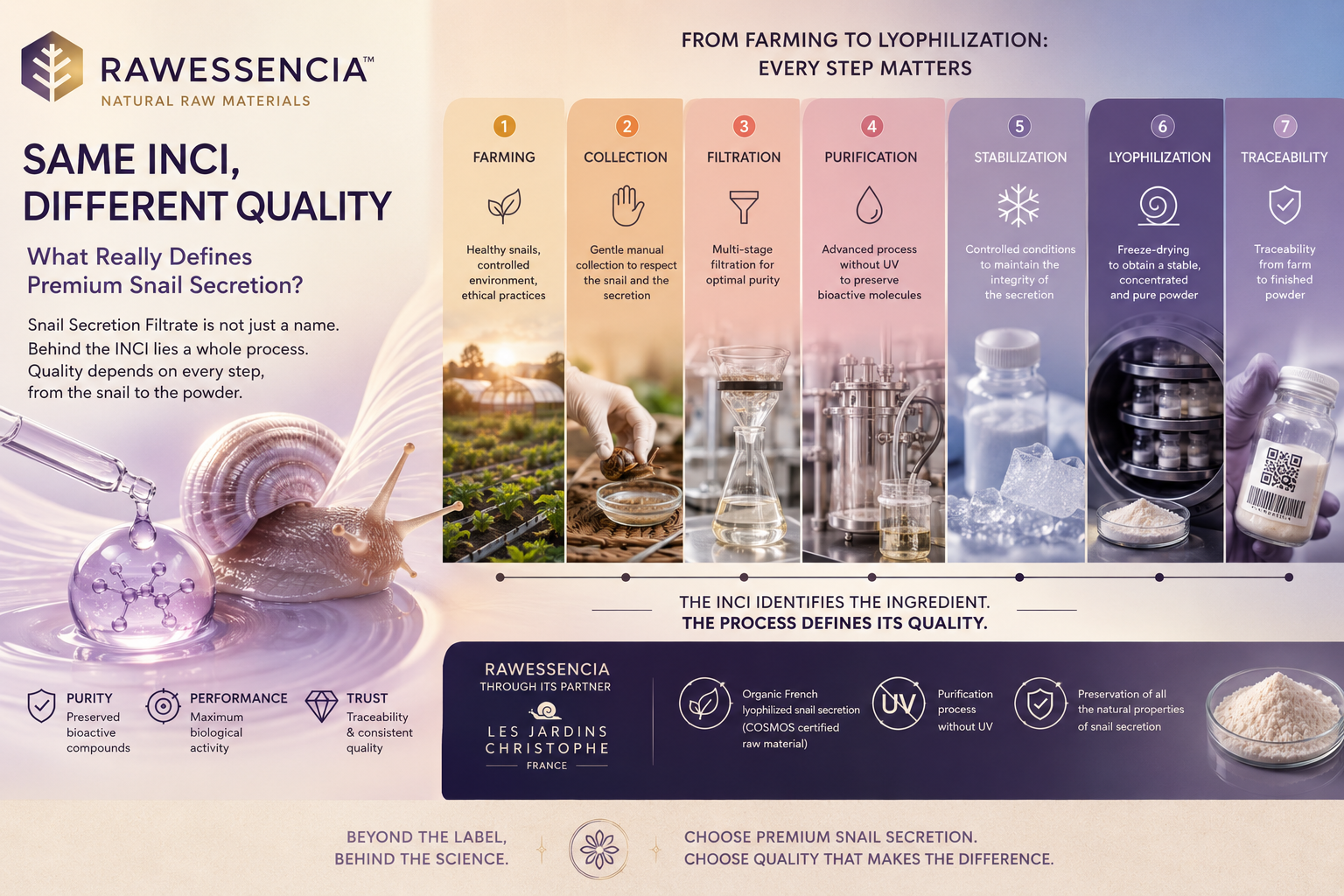
Same INCI, Different Quality: What Really Defines Premium Snail Secretion?
From Farming to Lyophilization: Why Collection Methods, Purification and Traceability Determine the Quality of Snail Secretion Filtrate
🔬 The Same INCI Does Not Mean the Same Raw Material
For a cosmetic formulator, two raw materials carrying the same INCI name: Snail Secretion Filtrate may appear equivalent.
In reality, they can be very different.
The INCI name identifies the nature of the ingredient used in a formulation, but it does not, by itself, describe the farming method, collection conditions, purification process, treatments applied to the secretion, or its stabilization method.
For a brand or laboratory, the question should therefore not simply be:
“What is the INCI name of your raw material?”
but also:
“How was this snail secretion collected and processed?”
🐌 Quality Starts with Collection
Snail secretion is a complex biological matrix containing proteins, glycoproteins and various compounds naturally present in the secretion.
Its quality therefore does not begin in the laboratory, but at the farming and collection stages.
The methods used can vary considerably: manual collection, mechanical processes, or techniques involving different types of stimulation.
For B2B buyers, it is therefore important to understand:
- the origin of the snails;
- how they are farmed;
- the collection method;
- hygiene conditions;
- the time between collection and processing;
- full batch traceability.
A premium raw material should be documented far beyond its simple INCI name.
⚗️ Purification: The Often-Overlooked Step
After collection comes a critical stage: purification.
Raw snail secretion obviously cannot be used as collected. It must be filtered and processed according to a controlled procedure in order to obtain a raw material suitable for cosmetic applications.
Some industrial processes use ultraviolet (UV) exposure as part of their microbiological treatment.
However, UV radiation can also interact with certain sensitive biological molecules. For a complex raw material, the purification strategy should therefore be considered a genuine quality parameter rather than simply an industrial processing step.
The objective is twofold: achieving the required microbiological quality while limiting, as far as possible, alteration of the compounds of interest.
❄️ Lyophilization Alone Is Not Enough
Lyophilization is a particularly valuable technology for stabilizing snail secretion.
By removing water through freezing followed by sublimation under vacuum, it produces a concentrated, lightweight raw material that is considerably easier to store and transport.
However, there is one fundamental point:
Lyophilization cannot restore what may have been altered beforehand.
The quality of lyophilized snail secretion therefore depends on the entire production chain:
Farming → Collection → Filtration → Purification → Stabilization → Lyophilization → Packaging
It is the control of this complete chain that makes the difference between a simple Snail Secretion Filtrate powder and a premium raw material intended for demanding dermocosmetic formulations.
🌿 The Rawessencia Approach: Different Levels of Sourcing
It is precisely around this concept of raw material control that Rawessencia has developed its offering for cosmetic professionals.
The range includes traditional lyophilized snail secretion, as well as a French organic lyophilized snail secretion produced by its partner Les Jardins Christophe.
For the latter, particular attention is paid to the entire process, from farming and collection through purification and lyophilization.
Les Jardins Christophe has notably developed a processing method that does not use UV radiation, with the objective of controlling microbiological quality while prioritizing the preservation of the biochemical integrity of the secretion before lyophilization.
This French organic raw material also benefits from COSMOS certification, providing brands with additional traceability and documentation for their formulation projects.
🔎 What Should a B2B Buyer Ask Their Supplier?
Before selecting snail secretion, a laboratory should therefore examine several criteria: origin, collection method, filtration and purification processes, whether UV treatment is used, stabilization method, microbiological analyses, batch-to-batch consistency, and traceability.
Price or the INCI name alone does not allow two raw materials to be properly compared.
For premium formulations, the true value lies in process control and consistent, reproducible quality.
🧬 Conclusion: Behind the INCI Lies an Entire Process
Snail Secretion Filtrate is an INCI name. It is not a quality grade.
Two raw materials carrying exactly the same designation may differ considerably in terms of sourcing, collection, purification, preservation and traceability.
And lyophilization, however effective it may be, is only the final part of this story.
For formulators and brands looking for premium snail secretion, it is therefore essential to look beyond the label and understand the entire process used to obtain the raw material.
Because in B2B cosmetics, it is not only what an ingredient contains that matters — it is also how its qualities have been preserved.