
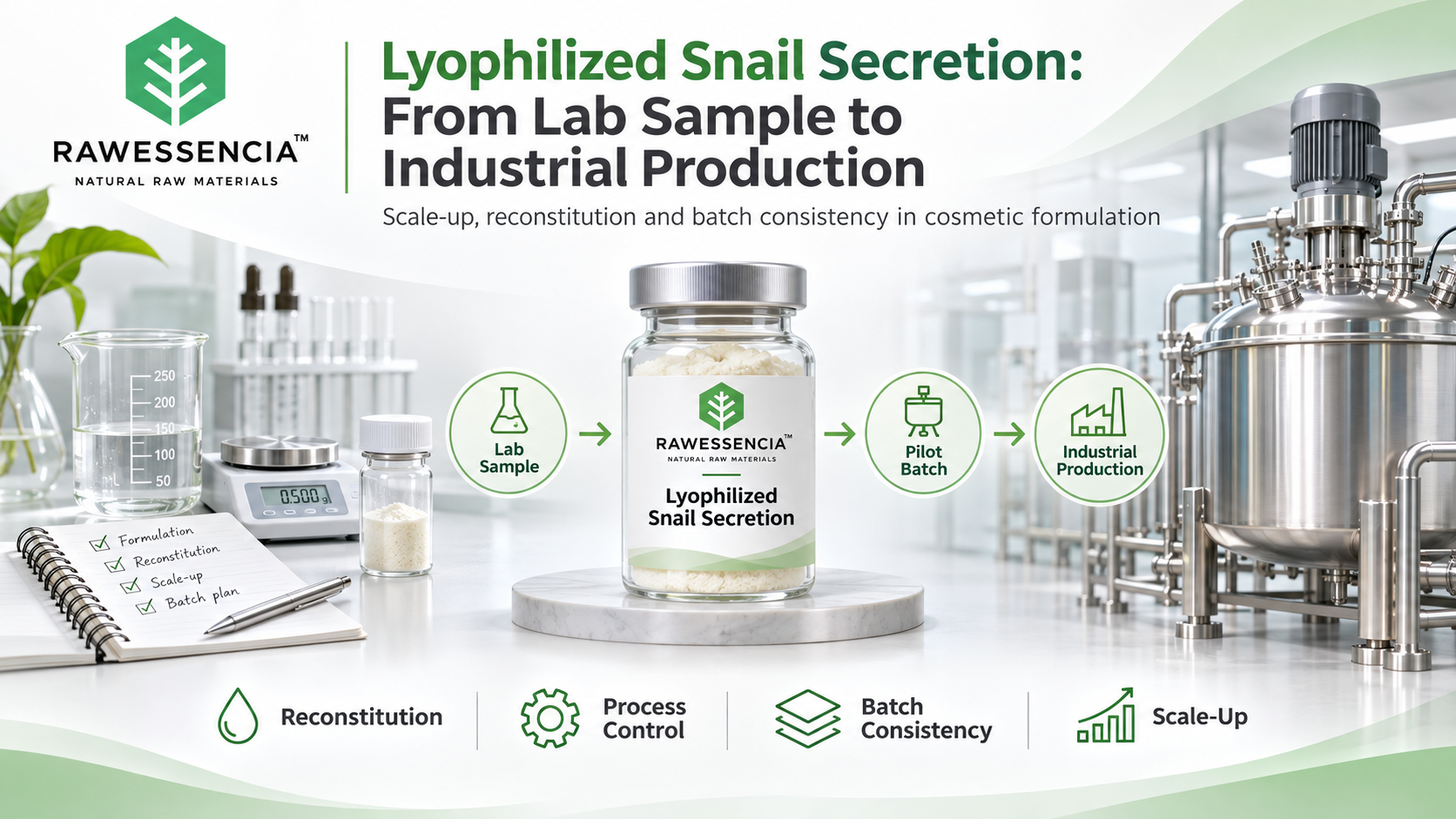
Lyophilized Snail Secretion: How to Scale from Lab Sample to Industrial Production
Reconstitution, Scale-Up and Batch Consistency: Critical Parameters to Control When Moving into Production
A formulation containing lyophilized Snail Secretion may perform perfectly during initial laboratory trials using only a few hundred grams of finished product. But what happens when the laboratory needs to manufacture 10, 50, 100 or 500 kg of the same formulation?
Moving from laboratory development to industrial production — the scale-up stage — is not simply a matter of multiplying every quantity.
Mixing time, agitation speed, temperature, order of addition and rehydration homogeneity can all behave differently as batch size increases.
With a concentrated biological raw material such as lyophilized Snail Secretion, controlling these parameters becomes particularly important.
The objective is therefore not to modify a formulation that already works, but to reproduce on a larger scale the conditions that delivered the expected result during laboratory development.
🔬 1. Understand the Raw Material Before Scaling Up
Before industrialization, the formulator should clearly understand the raw material being used.
Lyophilized Snail Secretion is not simply a powder added to a manufacturing vessel.
It is the result of several successive stages — collection, filtration, purification, stabilization and lyophilization — designed to transform a biological liquid secretion into a dry, concentrated raw material.
Lyophilization removes most of the water without requiring the high temperatures associated with certain other drying technologies.
For the formulator, this concentration provides an obvious advantage: very small quantities of raw material can be used to prepare much larger volumes of finished formulation.
However, this advantage also requires greater precision.
A weighing error, poor dispersion or incomplete rehydration can have a proportionally greater impact when working with a highly concentrated ingredient.
💧 2. Reconstitution Should Be Standardized
One of the first decisions for the formulator is whether the powder will be incorporated directly into the formulation or reconstituted beforehand.
In many manufacturing processes, controlled pre-dispersion or reconstitution in suitable-quality water can make it easier to achieve homogeneous incorporation.
The protocol established during R&D should therefore be documented precisely, including:
- amount of powder;
- quantity and quality of water;
- water temperature;
- rehydration time;
- mixing speed and equipment;
- appearance of the resulting solution;
- pH after reconstitution.
These parameters may seem relatively minor when preparing a few hundred milliliters in the laboratory.
They become considerably more important when the same operation must be reproduced in an industrial environment.
The fundamental principle is simple:
A protocol that works should be measured and documented before it is scaled up.
⚙️ 3. Scaling Ingredient Quantities Does Not Mean Scaling Mixing Parameters
This is one of the most common misunderstandings during scale-up.
If a 1 kg formulation becomes a 100 kg production batch, the ingredient quantities can normally be recalculated proportionally.
However, mixing speed and mixing time cannot necessarily be multiplied or maintained unchanged.
A laboratory stirrer and an industrial mixer do not generate the same mechanical forces.
Tank geometry, impeller diameter, impeller position, formulation viscosity and batch volume all influence product circulation and mixing efficiency.
Insufficient agitation can lead to poor dispersion.
Excessive agitation, on the other hand, may promote air incorporation, foaming or unnecessary mechanical stress without improving the process.
The objective is therefore not to achieve maximum agitation, but rather the level of mixing required to obtain a homogeneous and reproducible dispersion.
🌡️ 4. Incorporation Temperature Should Be Controlled
Snail Secretion is a complex biological matrix.
It contains different families of compounds that may have varying sensitivities to processing conditions.
In a hot-process emulsion, it is therefore generally preferable to determine the most appropriate stage for incorporating Snail Secretion, rather than exposing it unnecessarily to the entire thermal manufacturing cycle.
In practice, the incorporation stage should be defined during formulation development and maintained during scale-up.
If incorporation takes place during the cooling phase at laboratory scale, it should also take place under comparable thermal conditions during industrial manufacturing.
However, an indicative temperature should not automatically be treated as a universal rule.
The acceptable maximum temperature should be determined according to the specific raw material, its technical documentation and the formulation concerned.
⚗️ 5. Monitor pH Before and After Incorporation
pH is another important parameter.
During development, formulators should evaluate not only the final pH of the formulation, but also whether incorporation of the raw material influences it.
During scale-up, measurements should be taken only after the batch has been sufficiently homogenized.
A measurement taken too early, or from a poorly mixed part of the vessel, may produce a misleading result.
The final pH should remain compatible with:
- the developed formulation;
- the preservative system;
- the other ingredients;
- the intended application area;
- the specifications established by the laboratory.
Scale-up should reproduce a validated specification, rather than simply targeting a theoretical value.
🧪 6. Pay Particular Attention to the Preservative System
Lyophilization helps stabilize the dry raw material by greatly reducing the amount of available water.
However, once the powder is rehydrated or incorporated into an aqueous formulation, the situation changes completely.
It is therefore essential to distinguish between:
the microbiological stability of the lyophilized raw material
and
the microbiological protection of the finished cosmetic product.
The presence of Snail Secretion does not remove the formulator’s responsibility to develop and validate an appropriate preservative system for the finished formulation.
Compatibility with the preservative system and the microbiological robustness of the finished product should be assessed according to the appropriate procedures for the product concerned.
📊 7. The Real Challenge: Batch-to-Batch Reproducibility
Successful industrialization does not simply mean producing one satisfactory 100 kg batch.
The manufacturer must be able to produce the same product again in the next batch.
The laboratory should therefore define the parameters that need to be monitored.
Depending on the formulation, these may include:
- appearance;
- color;
- odor;
- pH;
- viscosity;
- homogeneity;
- physical stability;
- microbiological quality;
- final weight or volume.
It is also advisable to retain information about the specific lot of Snail Secretion used.
This level of traceability makes it easier to determine whether an unexpected variation originates from the raw material, the manufacturing process or another component of the formulation.
🏭 8. The Pilot Batch Remains an Essential Step
Moving directly from a laboratory beaker to a large industrial production batch may be tempting when the formulation appears straightforward.
It is generally not the best strategy.
A pilot batch allows the formulation to be observed under equipment and processing conditions that more closely resemble full-scale manufacturing.
It can help evaluate:
- ease of dispersion;
- time required for homogenization;
- influence of temperature;
- potential foam formation;
- changes in pH;
- viscosity behavior;
- optimum order of incorporation.
Adjustments made at this stage often concern the manufacturing process rather than the formulation itself.
That is precisely the purpose of a well-managed scale-up.
📄 9. The COA Becomes Particularly Important in Regular Production
Once a product enters regular production, raw-material documentation becomes even more important.
The Certificate of Analysis (COA) links the controlled specifications to the actual lot received.
It complements other technical documents such as the TDS and, where applicable, the SDS.
For a biological raw material, the ability to identify individual lots and retain a documentary history is particularly valuable.
At Rawessencia, this traceability approach applies to both traditional lyophilized Snail Secretion and the French organic reference produced by Les Jardins Christophe.
❌ 10. Common Mistakes to Avoid During Scale-Up
Several common mistakes can be avoided relatively easily.
The first is changing batch size, manufacturing process and formulation at the same time. If a problem occurs, identifying its cause then becomes extremely difficult.
The second is failing to document laboratory trials precisely.
The third is assuming that a lyophilized powder can be incorporated in any way simply because it is easy to handle.
Finally, reconstitution should not be regarded as a separate operation from production.
Reconstitution is part of the manufacturing process and should therefore be reproducible.
🔎 From Laboratory to Factory: What Really Needs to Be Reproduced?
During scale-up, the objective is not to reproduce the size of the laboratory beaker or the exact rpm of the laboratory stirrer.
What needs to be reproduced is the outcome of the process:
a properly dispersed raw material, incorporated under controlled conditions and resulting in a formulation that meets the same specifications as the version validated during development.
This approach allows manufacturers to progress logically through:
Sample → R&D Prototype → Pilot Batch → Industrial Production
without having to reformulate the product systematically at every increase in scale.
🐌 Conclusion: Lyophilization Facilitates Industrialization, but the Protocol Makes the Difference
Lyophilized Snail Secretion offers clear advantages for formulators: reduced raw-material storage volume, easier handling, stability in dry form and the ability to prepare only the quantities required for each development project.
However, a concentrated raw material also requires a precise manufacturing process.
Weighing, reconstitution, temperature, agitation, order of incorporation, pH, preservation and traceability should all be defined during development and then transferred methodically into production.
For R&D teams, the most effective approach is therefore to consider lyophilized Snail Secretion not simply as a powder added to a formulation, but as a technical raw material whose handling protocol forms an integral part of the formulation process.
It is this level of process control that enables an excellent laboratory prototype to become a stable, reproducible and well-documented industrial product.