
🧪 How to Evaluate the Quality of Lyophilized Snail Secretion
The Criteria Every B2B Buyer Should Check Before Choosing a Supplier
Snail secretion has progressively established itself as a sought-after raw material in cosmetic and dermocosmetic formulations. However, as the market develops, laboratories and brands face an important challenge: how can two lyophilized snail secretion products from different suppliers be objectively compared?
The same INCI name does not necessarily mean the same quality. Price, powder appearance, or even a satisfactory sample are not sufficient to evaluate a raw material intended for professional production.
For B2B buyers, supplier selection should therefore be based on a combination of measurable and documented criteria.
1. 🔬 Identify Exactly What Raw Material Is Being Offered
The first step may seem obvious, but it is essential: know exactly what you are buying.
A powder marketed as snail secretion can be produced using different processes and may have very different characteristics.
Buyers should know, in particular:
- the snail species used;
- the geographical origin of the raw material;
- the exact nature of the product before lyophilization;
- the possible presence of carriers, excipients or additives;
- the concentration and drying process;
- the recommended storage conditions.
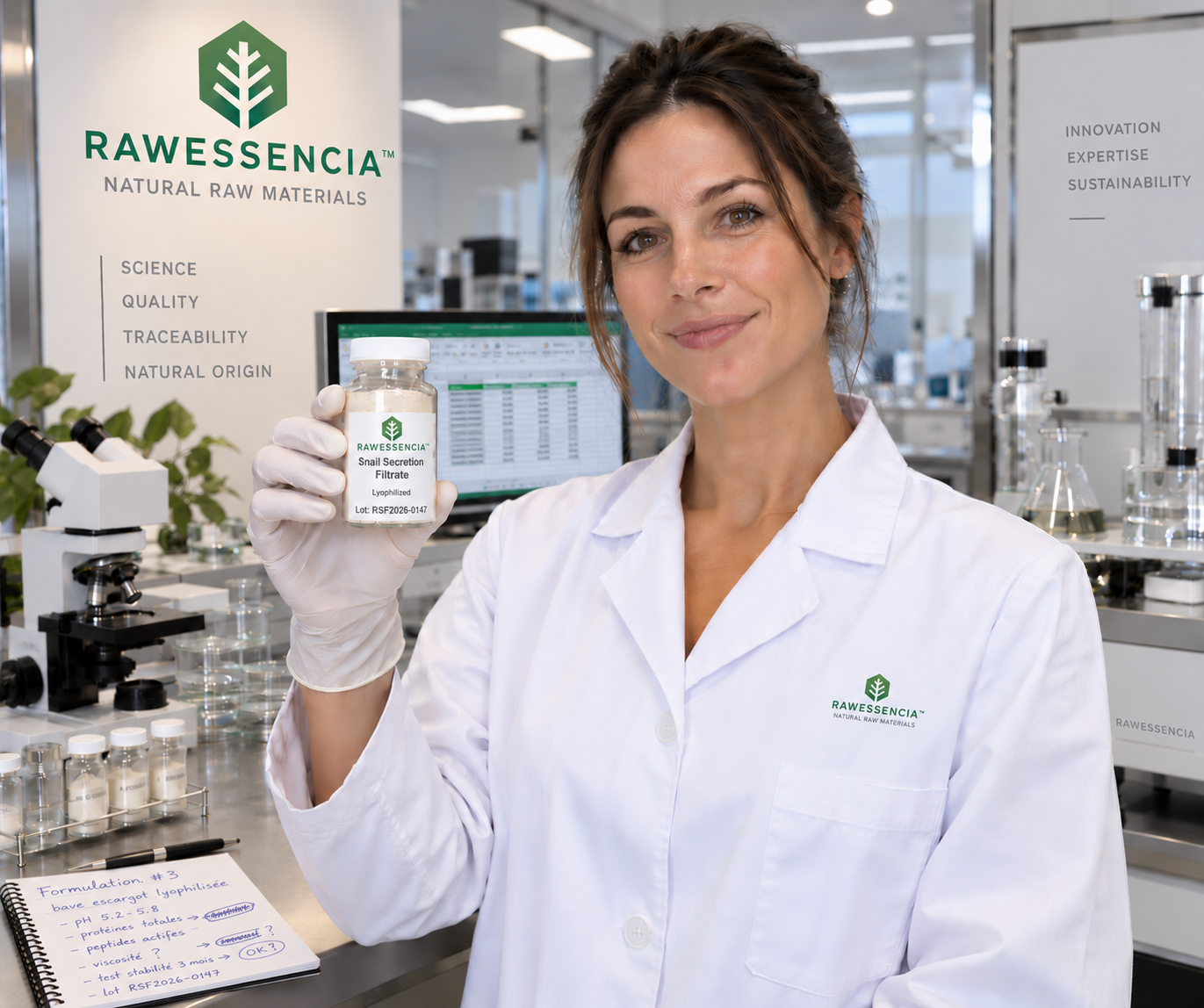
At Rawessencia, the raw material is derived from the secretion of Helix aspersa Müller and is supplied in lyophilized form for professional applications.
The objective is to provide a concentrated, stable raw material that can be readily incorporated into formulation processes.
2. ⚗️ Look Beyond Lyophilization: Examine the Purification Process
Lyophilization is important, but it takes place after several critical processing stages.
Before being freeze-dried, snail secretion must notably be collected, filtered and purified.
The purification process therefore deserves particular attention.
A professional buyer should ask the supplier:
How is the raw material purified? What treatments are applied before lyophilization? Is UV exposure used at any stage of the process?
This question matters because some biological constituents may be sensitive to processing conditions. The objective of a controlled process is therefore to achieve the required microbiological quality while limiting, as far as possible, alteration of compounds of interest.
For its French organic production, Rawessencia’s partner Les Jardins Christophe notably uses a treatment process without UV exposure prior to lyophilization.
This technological choice is intended to limit treatments that could potentially affect the biological matrix before stabilization.
3. 🧬 Do Not Rely on a Marketing List of Molecules
Collagen, elastin, allantoin, glycolic acid, proteins, peptides, glycoproteins…
The literature on snail secretion describes numerous constituents of potential interest for cosmetic applications.
However, for a B2B buyer, a list of molecules on a commercial brochure is not, by itself, sufficient characterization of a specific batch.
It is important to distinguish between the composition generally described for snail secretion and the characteristics actually documented for the raw material being offered.
Where available, analytical data, technical specifications and the analytical methods used provide considerably more meaningful information than a simple list of marketing claims.
A premium raw material should be documented, not merely described.
4. 🦠 Examine Microbiological Quality
This is one of the fundamental criteria for a raw material of biological origin.
Microbiological specifications help verify the conformity of the product before its incorporation into cosmetic formulations.
Depending on the product, its intended application and the specifications agreed with the supplier, buyers should review the microbiological parameters provided in the Certificate of Analysis (COA).
Another essential point must be understood: lyophilization is not, by itself, a sterilization method.
Its primary purpose is to remove water and stabilize the material. Microbiological control therefore depends on the entire process: collection, hygiene, filtration, purification, handling, lyophilization and packaging.
5. 📊 Check Batch-to-Batch Consistency
For a laboratory, receiving an excellent sample is one thing.
Receiving the same level of quality six months or two years later is another.
Batch-to-batch consistency is a major consideration when moving from R&D development to industrial-scale manufacturing.
Significant variations in raw materials may influence color, odor, solubility, physicochemical characteristics or even the behavior of the finished formulation.
A B2B supplier should therefore have a sufficiently controlled process to ensure consistent quality over time, in accordance with established specifications.
For a cosmetic brand, consistency is almost as important as the quality of the first batch tested.
6. 📄 Require Proper Technical Documentation
A professional raw material should be supported by appropriate documentation.
Depending on the product and the customer’s requirements, it may be relevant to request:
- TDS – Technical Data Sheet;
- SDS – Safety Data Sheet;
- COA – Certificate of Analysis;
- INCI identification;
- raw material origin;
- batch number;
- available physicochemical and microbiological specifications;
- storage conditions;
- shelf life;
- traceability information;
- applicable regulatory documentation or certificates.
This documentation is particularly important for formulators, quality managers and safety assessors.
It also helps avoid a common mistake: comparing two raw materials solely on price.
7. 🌿 Verify What “Organic” Actually Means
The term “organic” must also be supported by documentation.
For a professional buyer, it is not enough for a raw material to be commercially described as organic. Buyers should determine what certification exists, which standard applies and exactly which raw material is covered by the certificate.
Alongside its traditional range, Rawessencia offers a French organic lyophilized snail secretion produced by Les Jardins Christophe.
The raw material BAVE D’ESCARGOT LYOPHILISÉE HELIX ASPERSA MÜLLER is listed on a certificate issued by Ecocert Greenlife according to the COSMOS Version 4 standard, under the “raw material” category. The document notably indicates 100% physically processed agro-ingredients from organic farming (PPAI BIO) and 0% synthetic ingredients.
For brands seeking to develop premium or organic product lines, this documented distinction can be an important factor when selecting a raw material.
🔎 The B2B Checklist Before Ordering
Before selecting a supplier of lyophilized snail secretion, a buyer should therefore be able to answer the following questions:
Which snail species? What origin? What collection method? What purification process? What treatments are applied before lyophilization? Are there any additives or carriers? What are the microbiological specifications? Is a COA available? What level of traceability is provided? How consistent is the product from batch to batch? And, when certification is claimed, which certificate actually covers the raw material?
If several of these questions remain unanswered, the lowest price is not necessarily the most economical option for an industrial project.
Variations in quality or insufficient documentation can ultimately cost considerably more during formulation, validation or production.
🐌 Conclusion: Buying a Raw Material Also Means Buying Control of Its Process
When selecting lyophilized snail secretion for professional formulation, price or the INCI name alone cannot determine the actual quality of the product.
The real differences lie behind the label: origin, farming, collection, purification, microbiological control, lyophilization, analytical testing, traceability and batch-to-batch consistency.
These are precisely the factors B2B buyers should use when comparing suppliers.
A good supplier should not simply be able to sell lyophilized snail secretion. They should be able to explain, document and trace the raw material they supply.
For Rawessencia, this approach is the foundation of a long-term B2B relationship with laboratories and cosmetic brands: providing traditional or organic raw materials supported by the technical information required for their evaluation and professional use.