
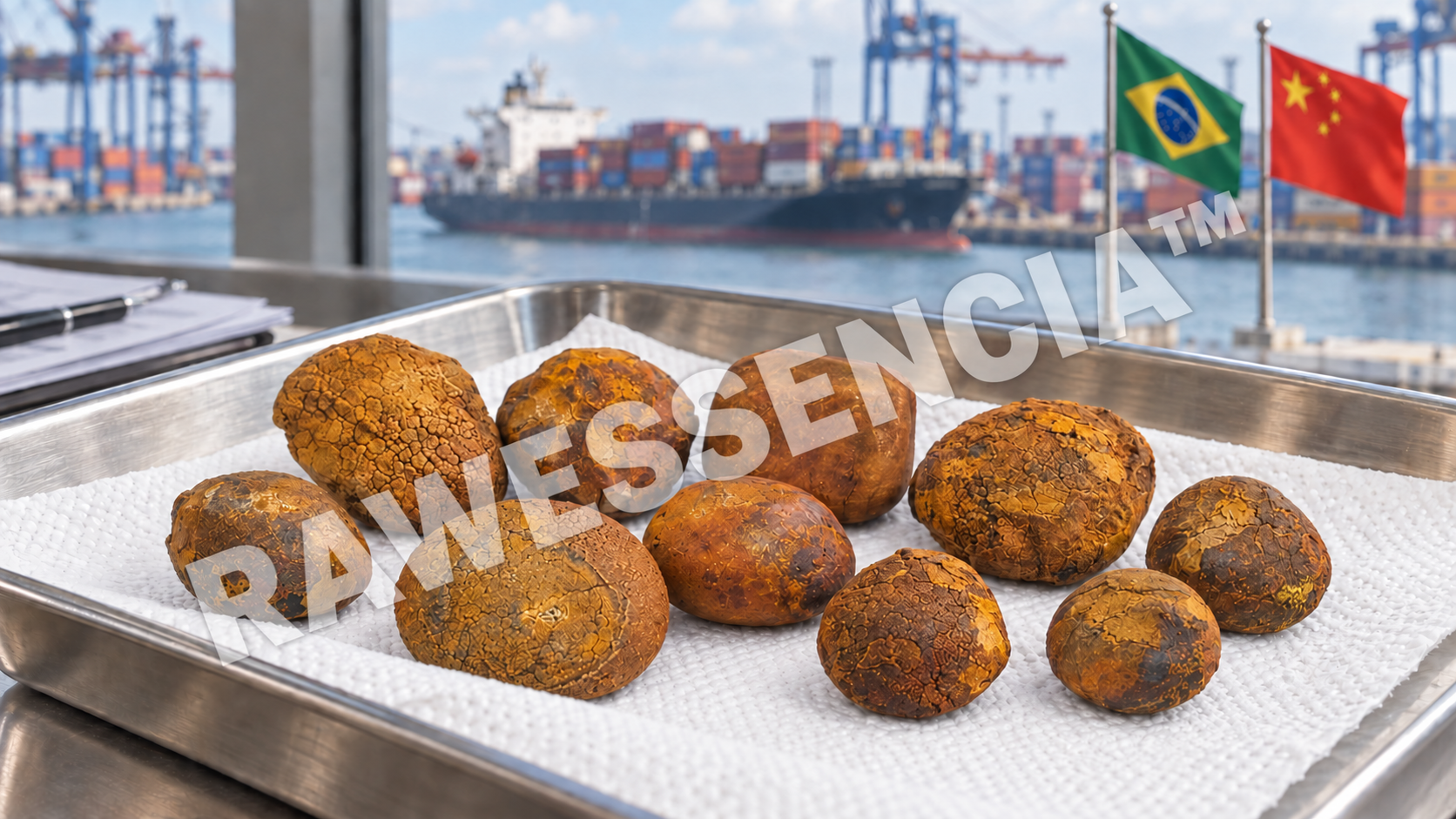
China opens its market to Brazil
In September 2026, the bovine gallstone market reaches a new milestone: China is clarifying the import requirements for Brazilian products, while trade with other South American countries is taking more concrete shape. For slaughterhouses, collectors and traders, this opening broadens commercial opportunities. It comes, however, at a time when buyers remain cautious and prices reported in China require careful interpretation. [1, 2, 6]
Brazil gains regulated access to the Chinese market
On 27 July 2026, the Brazilian authorities announced the signing of a sanitary protocol authorising bovine gallstone exports to China. A further step followed with Chinese Customs Announcement No. 130, dated 3 September and republished on 4 September 2026, which sets out the applicable requirements. [1, 2]
The announcement covers dried gallstones from cattle raised in Brazil. Its requirements include traceability back to the farm of origin, specific sanitary conditions and registration of the establishments concerned with the Chinese authorities. Shipments must be accompanied by an official health certificate. [2]
This development makes it possible to broaden the supply of compliant products. Its effect on volumes and prices will nevertheless depend on which establishments are actually registered, the quantities available and the purchases made. Country-level authorisation alone therefore does not indicate the scale of future deliveries.
From import trials to supplies for manufacturing
In our January article, we discussed the first Chinese import trials. Several further steps have since been documented. On 12 March 2026, Chinese Customs published the sanitary requirements for importing Uruguayan gallstones, covering the origin of the animals, the establishments involved, and the preparation and certification of batches. [3]
In June, progress was also made with imports from Argentina. The Xiamen Institute for Food and Drug Control announced that, on 23 June 2026, it had completed checks on a batch of natural gallstones imported by Pien Tze Huang for use in manufacturing. [4]
The commercial focus is therefore shifting towards the ability to organise deliveries that manufacturers can use. Regulatory access, quality controls and supplier reliability are becoming practical considerations in negotiations.
Chinese prices show greater stability over the summer
Market bulletins from late July and late August 2026 suggest relative price stability in the Chinese markets observed. In Bozhou, YaoTong reported on 29 July that traders were favouring frequent purchases and quick resale. In Anguo, Zhongyaocai Tiandi reported on 31 August that buyers were purchasing as needed, amid a wait-and-see approach. [5, 6]
This relative stability follows a decline in prices. It is not enough to establish a sustained recovery in the global market. The trends observed in these specialised Chinese markets concern specific product categories and do not determine the purchase terms offered to a European supplier.
Assessing a batch requires comparing equivalent conditions: accepted quality, dry weight, the proportion of whole stones and fragments, documented origin, delivery location and payment terms. The general market trend is no substitute for this individual assessment.
Manufacturers seek better cost control
The latest publications from manufacturers also call for caution about the idea of continuously growing demand. In its first-half 2026 report, published in late August, Pien Tze Huang reported a 14.98% decline in consolidated revenue compared with the first half of 2025. The group also stated that falling prices for certain raw materials and the opening of gallstone imports were helping it manage supplies and costs. [7]
One company’s results cannot, on their own, measure global demand for natural gallstones. They do, however, show why actual production needs, inventories and manufacturers’ purchasing policies should be monitored alongside announcements of new market access.
Market access restricted to authorised channels
The Chinese pilot framework launched in April 2025 provides for a two-year trial across twelve provinces and municipalities. Importers must hold marketing authorisations for the medicines concerned and be based in the pilot areas. Imported gallstones are intended for their own production or that of designated companies within their group in those areas; resale to third parties is prohibited under this framework. [8]
For suppliers, this means that the buyer’s identity and the destination of the batch must be checked as carefully as its quality. Entry requirements for mainland China must be examined for the specific supply route being considered. An agreement covering one country of origin does not amount to blanket authorisation for all origins.
Traceability is a condition of access: the framework requires tracking that covers, among other stages, preparation at origin, importation, transport, storage and use in manufacturing. [8]
What these developments mean for industry professionals
Our interpretation of these developments is that the ability to supply a documented batch is becoming more important in this market. Newly authorised countries of origin may increase competition among suppliers and make it easier to diversify sourcing. The extent of this effect will depend on the trade flows actually established.
For slaughterhouses and collectors, the most useful action is to prepare a precise description of each batch: clear photographs, weight after drying, origin, collection dates and storage conditions. It is also preferable to keep batches from different origins separate to make them easier to identify.
For traders, the next indicators to monitor will be new establishment registrations, confirmed delivery announcements and changes in purchasing by manufacturers. Price comparisons must remain tied to a specific quality and date. The summer observations provide reference points for discussion, but do not allow year-end prices to be predicted.
Offer a batch to Rawessencia
Are you an industry professional with bovine gallstones to sell? Send Rawessencia photographs of the batch, its dry weight and any available information on its origin. We can assess your offer based on the batch’s characteristics and market conditions at the time of evaluation.
Contact Rawessencia to offer a batch
Sources and links
[1] Brazilian ministries MAPA and MRE. Announcement of the sanitary protocol with China, 27 July 2026. View source
[2] Chinese Customs. Announcement No. 130 of 2026, dated 3 September 2026, republished on 4 September by the Zhejiang International Trade Single Window. Requirements applicable to Brazilian gallstones. View source
[3] Chinese Customs. Announcement No. 25 of 2026, dated 12 March 2026, republished by China’s Ministry of Commerce. Requirements applicable to Uruguayan gallstones. View source
[4] Xiamen Institute for Food and Drug Control. Statement dated 1 July 2026 on checks completed on 23 June for an Argentine batch intended for manufacturing. View source
[5] YaoTong. Market bulletin dated 29 July 2026 on natural gallstones in the Bozhou market. View source
[6] Zhongyaocai Tiandi. Market bulletin dated 31 August 2026 on natural gallstones in the Anguo market. View source
[7] Zhangzhou Pien Tze Huang Pharmaceutical. 2026 interim report, published in late August 2026 and reproduced by Sina Finance. Key indicators and the section on raw material risks. View source
[8] NMPA and Chinese Customs. Announcement No. 25 of 2025, dated 18 April and published on 21 April 2025, republished by the Shanghai Medical Products Administration. Pilot framework for imports for pharmaceutical manufacturing. View source
Internal links for publication
Beijing tests market opening for a strategic ingredient
The bovine gallstone market and the price correction