
牛黄: Beijing Tests the Opening of a Strategic Ingredient in Traditional Medicine
By our editorial staff – Beijing / Xiamen
The confirmation, in mid-January, of the first official import of bovine gallstones into China marks a turning point for a market that is both highly restricted and strategically important. Behind a symbolic volume, Beijing is outlining a response to the chronic tensions affecting the supply chain of traditional Chinese medicine, while maintaining tight control over an ingredient classified among the most sensitive in the national pharmacopeia.
A Discreet Pillar of Traditional Chinese Medicine
牛黄 (Calculus bovis) occupies a unique position in traditional Chinese medicine (TCM). Present in certain emblematic formulations, particularly those used in acute conditions, it is regarded as an ingredient of high therapeutic value and strong symbolic significance. Its availability directly conditions the production of several medicines considered strategic for China’s healthcare system.
Unlike other substances of plant or mineral origin, natural 牛黄 is characterized by structural scarcity. It appears only under very specific biological conditions in cattle, which naturally limits supply and makes any increase in production difficult to anticipate or plan.
A Supply Chain Under Constant Strain
For several years, Chinese specialized media have described a supply chain subject to permanent constraints. Demand, driven by the consumption of TCM medicines and by population aging, remains strong. Supply, by contrast, relies almost exclusively on limited and irregular domestic resources.
In response, industrial substitutes have been developed and incorporated into certain formulations under strict regulatory oversight. While these alternatives play an important role in maintaining supply continuity, they do not cover all medical uses, which preserves the strategic importance of natural 牛黄 for part of the pharmaceutical industry.
A First Pilot Import With Strong Symbolic Significance
It is against this backdrop that an unprecedented announcement emerged in mid-January: the first official import of natural 牛黄 into China, recognized by authorities and widely reported by national and provincial media.
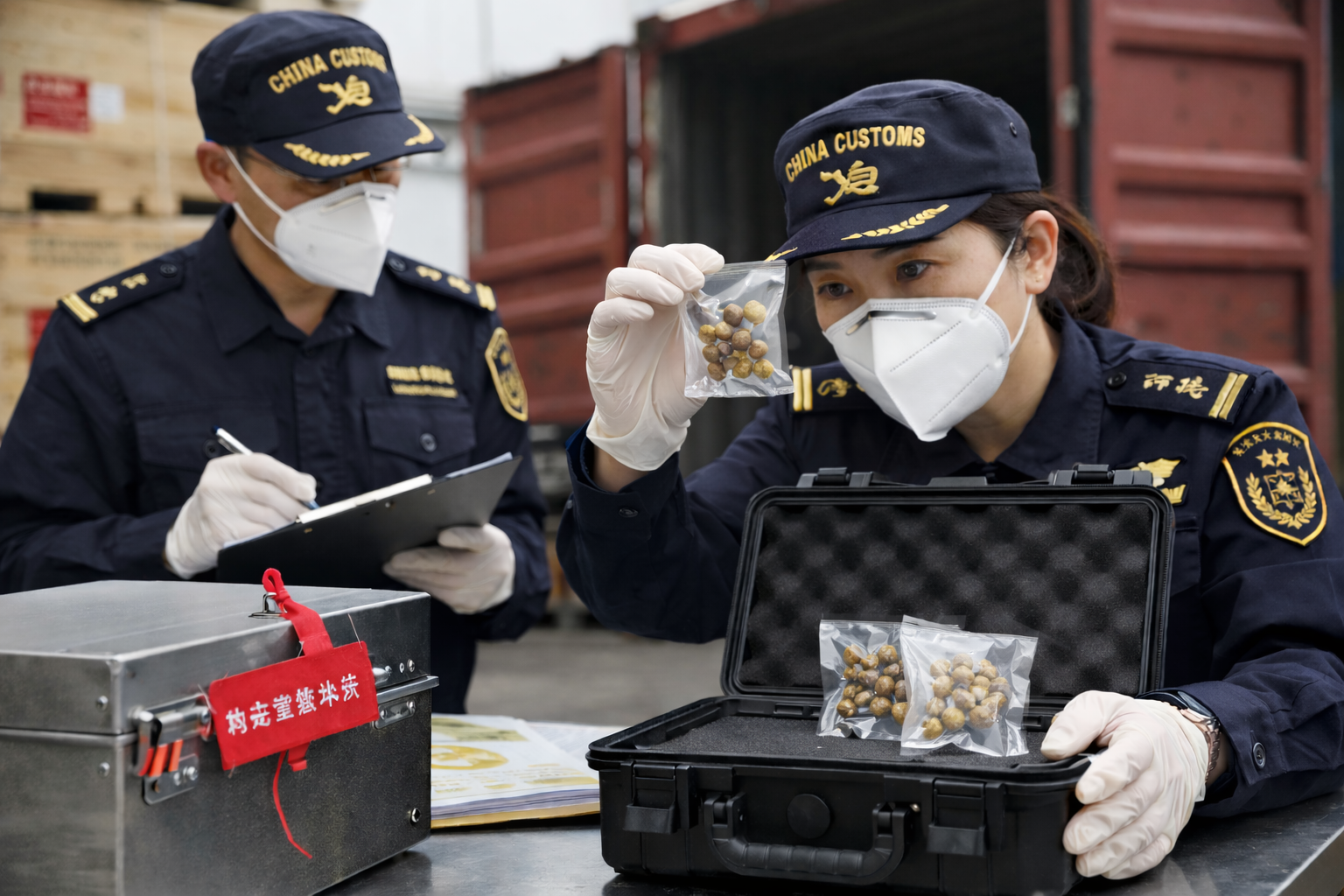
According to these reports, a shipment originating from South America entered Chinese territory through the port of Xiamen, in Fujian Province. The operation was presented as a national first, carried out within the framework of a pilot program involving customs, health, and industrial authorities.
Chinese media emphasize the deliberately limited nature of this import, designed primarily as a test of procedures: quality controls, traceability, regulatory compliance, and integration into the existing pharmaceutical supply chain.
An Opening Strictly Controlled by Authorities
Far from representing a market liberalization, this initiative reflects a strategy of carefully calibrated and gradual management. Authorities are seeking to explore new sourcing options without calling into question the control principles surrounding a sensitive ingredient used in public health–related products.
Specialized media note that this approach serves multiple objectives simultaneously: securing supply flows, preventing health risks, curbing speculative behavior, and offering greater medium-term visibility to manufacturers. The pilot program also makes it possible to test cooperation with foreign suppliers within a strictly defined framework.
Direct Implications for the Pharmaceutical Industry
The announcement of this import immediately drew the attention of players in traditional and integrative pharmacy. Chinese financial media linked the development to leading sector groups for which 牛黄 represents a critical input in certain production lines.
For these manufacturers, the prospect of an import channel—even an experimental one—opens the door to source diversification and a potential reduction in supply disruption risks. It could also facilitate industrial planning and inventory management in an environment previously marked by high uncertainty.
Nevertheless, observers remain cautious: the actual impact will depend on how the pilot program evolves, whether it is expanded, and the volumes ultimately authorized.
A Strategic Signal Rather Than an Immediate Shift
In the short term, Chinese media assess that the primary effect of this initiative is above all strategic and anticipatory. By officially recognizing an import of natural 牛黄, the state sends a clear message: the market remains under close supervision, but it is no longer completely static.
This development could serve as a reference point for the management of other rare ingredients in the traditional pharmacopeia facing similar constraints. For now, 牛黄 remains a singular product, situated at the intersection of medical tradition, pharmaceutical industry, and health policy.
The experience launched in Xiamen will therefore be closely watched by the entire value chain. It may mark the beginning of a new phase—defined not by abrupt opening, but by a gradual adaptation of supply mechanisms for a key ingredient in China’s healthcare system.