
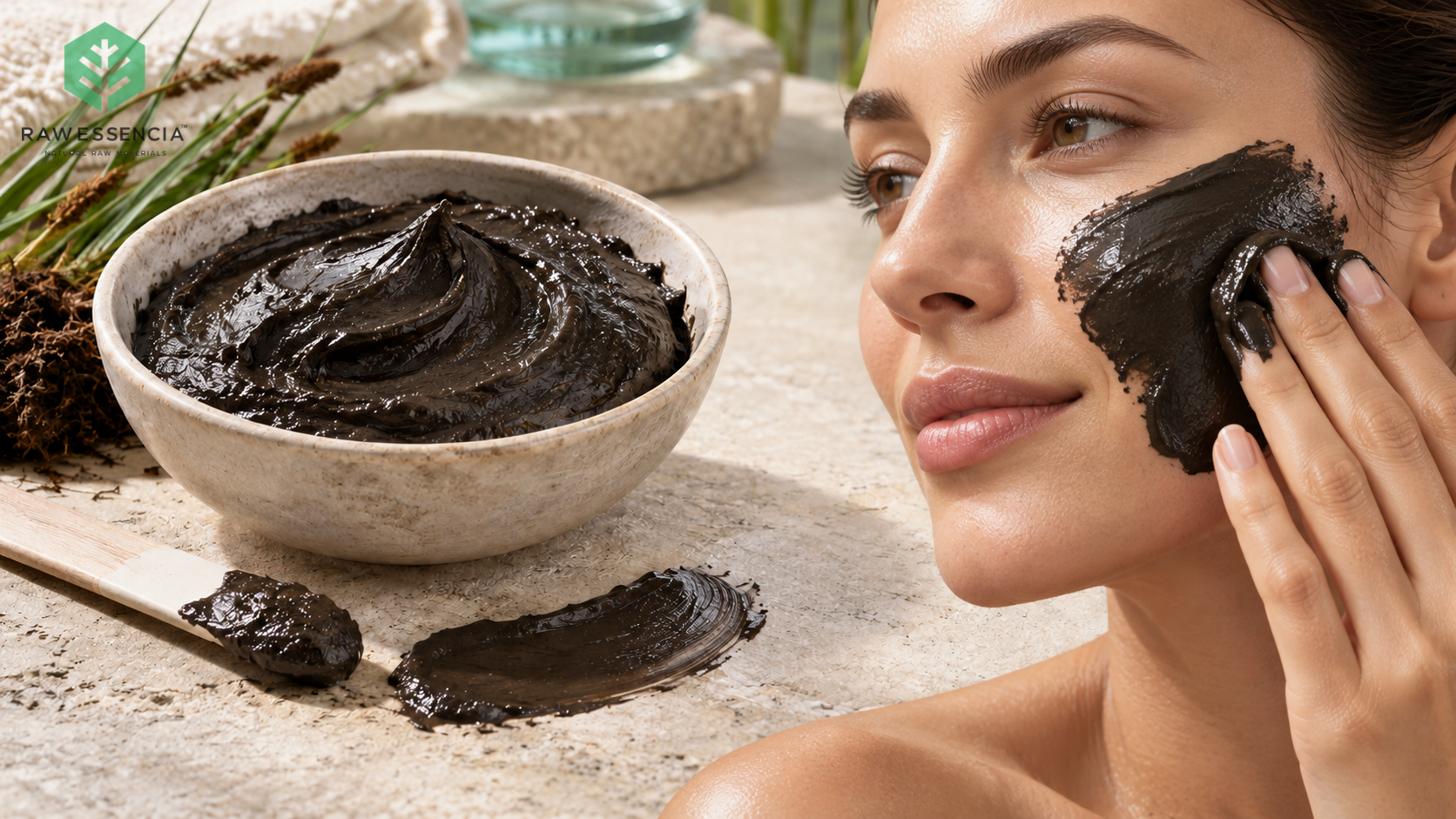
How to Qualify Torreblanca Cosmetic Moor Mud for B2B Cosmetic Formulation
Natural origin is important, but it is not enough to qualify a raw material for a professional cosmetic project.
For a cosmetic brand, laboratory, contract manufacturer or spa supplier, the real questions are more practical:
- Can the material be identified and traced?
- Is its physical and chemical profile documented?
- Will it behave consistently during production?
- Has its moisture, microbiological quality and packaging compatibility been assessed?
- Can the final product be supported with appropriate cosmetic claims?
TURBACOSM™ Cosmetic Moor Mud is a ready-to-use black peat raw material sourced from the Cabanes–Torreblanca peatlands in Castellón, Spain. This article provides a practical qualification framework for professionals who are considering Torreblanca Cosmetic Moor Mud for face masks, body treatments, scalp-care products, spa rituals or other rinse-off cosmetic applications.
1. Start with the identity of the raw material
Moor Mud is not simply a dark-coloured clay. Torreblanca Cosmetic Moor Mud is a naturally wet, strongly humified sedge peat selected from the deeper layers of the Cabanes–Torreblanca peatlands.
The origin and nature of the material matter because they influence its colour, texture, organic fraction, moisture content, odour and behaviour in a finished formula. A professional supplier should be able to explain:
- Where the peat is extracted.
- Which natural fraction is selected.
- How the material is screened and refined.
- How it is homogenised.
- How it is packed and protected during storage.
- How the batches are identified and traced.
For TURBACOSM™, the natural fraction is screened to remove possible wood residues and other foreign particles. It is then finely milled, homogenised and packed in airtight packaging. This processing step is important for professionals because a pleasant mask application depends not only on the botanical or geological origin, but also on the physical consistency of the material.
2. Read the technical profile before testing a formula
A sample can look attractive and still be unsuitable for a project if the technical profile is not understood. The following reference characteristics are particularly relevant when evaluating Torreblanca Cosmetic Moor Mud:
| Technical characteristic | Reference profile | Why it matters to professionals |
|---|---|---|
| Raw material | Strongly humified black sedge peat | Defines the material as Moor Mud rather than a conventional clay |
| Humification | Von Post H9–H10 | Indicates a highly decomposed peat structure |
| pH | 6.5–7 | Helps the formulator anticipate the pH range of the raw material |
| Water content | Approximately 86 wt% in the wet material | Directly affects dosage, preservation, viscosity, transport and packaging |
| Ash content | Approximately 20% | Contributes to the mineral fraction and the sensory profile |
| Humic acids | Approximately 25% | Supports the positioning of the material as a humic peat ingredient |
| Fulvic acids | Approximately 7% | Complements the declared humic fraction |
| Natural trace elements | Including copper, iron, magnesium, manganese, zinc, sodium, calcium, boron and molybdenum | Useful for technical characterisation and product positioning |
These figures are reference values from the product technical documentation. The exact documentation to be used for a commercial project should always be confirmed for the relevant batch and destination market.
3. Treat Moor Mud as a wet raw material, not as a dry powder
One of the most important formulation points is often overlooked: Cosmetic Moor Mud is supplied as a naturally wet material.
With a reference water content of approximately 86%, it should not be handled like a dry mineral powder. This changes the way a formulator calculates the formula and evaluates the product:
- the water phase of the finished product must be considered;
- the effective amount of peat solids must be calculated;
- the raw material can influence viscosity and spreadability;
- the product may require a suitable preservation strategy;
- microbiological quality must be evaluated at raw-material and finished-product level;
- the packaging must prevent drying and limit unwanted water loss;
- transport and storage conditions can affect the sensory consistency.
For a direct professional mask or spa treatment, the natural moisture of the peat is part of the ready-to-use experience. For a formulated cosmetic product, however, the water introduced by the Moor Mud must be included in the full formulation assessment.
The absence of added preservatives in the raw material does not automatically mean that a finished water-containing cosmetic can be marketed without a preservation system. The finished product, its packaging, its opening method and its intended period of use must be assessed together.
4. Check processing quality and physical consistency
The supplier’s processing method should be considered part of the raw-material specification.
For a professional application, the following characteristics are worth checking on each representative sample:
- colour uniformity;
- absence of visible wood residues or foreign particles;
- smoothness and particle feel during application;
- ease of spreading in a thick layer;
- ease of rinsing;
- odour consistency;
- absence of unwanted liquid separation;
- compatibility with the planned jar, tube, sachet or professional container.
Screening, milling and homogenisation help make the material easier to handle. Airtight packaging helps preserve the original moisture level and reduces the risk of drying. The material should also be protected from excessive heat, freezing and prolonged exposure to air.
For larger projects, it is good practice to compare more than one sample from the same supply programme. This allows the laboratory or purchasing team to distinguish a normal natural variation from a true quality deviation.
5. Select the right application route
Torreblanca Cosmetic Moor Mud can be evaluated through several professional routes, but each route requires a different development approach.
Ready-to-use professional masks
This is the most direct application. The natural paste can be used as a face, body, hand, foot or spa-treatment mask, subject to the professional protocol and the intended cosmetic positioning.
The development focus should be on:
- application thickness;
- contact time;
- rinsability;
- skin feel after removal;
- packaging ergonomics;
- storage and hygiene during repeated professional use.
Rinse-off facial and body products
When Moor Mud is included in a finished rinse-off product, the laboratory should evaluate the interaction between the peat, the water phase, the thickener system, the surfactants and any additional powders or extracts.
The objective is not simply to preserve the black colour. The formula should remain homogeneous, pleasant to apply and easy to remove without excessive residue.
Scalp-care and foot-care products
The same raw material can create a different sensory experience depending on the application area. A scalp product may require different particle size, rinseability and packaging considerations from a foot or hand treatment.
These applications should be positioned as cosmetic care or professional spa care unless specific evidence supports a more precise claim.
Creams, gels and bespoke treatment formulas
A laboratory may also evaluate Moor Mud in a gel, emulsion or treatment paste. In this case, the raw material should be introduced progressively during laboratory trials while monitoring:
- pH;
- viscosity;
- homogeneity;
- sedimentation;
- colour transfer;
- odour;
- microbiological stability;
- packaging compatibility.
The optimum use level cannot be defined universally. It depends on the desired sensory result, the total solids content, the rest of the formula and the intended use of the finished product.
6. Use a simple B2B qualification protocol
Before approving a raw material for scale-up, a brand or laboratory can use the following seven-step protocol:
- Request a representative sample identified with the relevant batch or lot information.
- Review the technical documentation, including the technical data sheet, safety data sheet and available batch certificate.
- Record the initial condition of the sample: colour, odour, texture, moisture, visible homogeneity and packaging integrity.
- Measure the relevant parameters using a documented internal method, such as pH and consistency.
- Prepare a small laboratory trial, for example a 100–500 g bench batch, adapted to the intended application.
- Evaluate stability and microbiological performance at finished-product level, using conditions appropriate to the formula and packaging.
- Approve the claim language and production specification only after the technical and regulatory review is complete.
This process reduces the risk of approving a raw material on the basis of appearance alone. It also creates a shared reference between purchasing, R&D, quality control, regulatory affairs and marketing.
7. Request the right information from the supplier
When sourcing a professional cosmetic Moor Mud, the following checklist can save time during supplier qualification:
| Information to request | Why it is useful |
|---|---|
| Exact geographical origin | Supports traceability and product storytelling |
| Raw-material description | Confirms whether the material is peat, clay, algae-based mud or a blend |
| Humification and pH data | Helps the laboratory compare suppliers and batches |
| Moisture and ash values | Essential for dosage calculations and process control |
| Particle and physical-processing information | Helps predict application feel and rinseability |
| Microbiological and contaminant data | Supports raw-material and finished-product safety assessment |
| Preservative status | Prevents confusion between the raw material and the finished formula |
| Packaging and storage conditions | Protects moisture and physical consistency |
| Batch documentation and traceability | Supports quality management and customer files |
| MOQ, formats and lead time | Helps purchasing and production planning |
A serious B2B evaluation should connect these technical points with the intended market, formula type, packaging and annual volume.
8. Build cosmetic claims around evidence
Natural origin and traditional spa use can support the identity and storytelling of a product, but they do not replace cosmetic claim substantiation.
For a finished cosmetic product, it is safer to build communication around claims such as:
- cleansing;
- purifying;
- smoothing;
- exfoliating, where supported by the finished product;
- mineral-rich or humic peat positioning, where supported by documentation;
- spa-inspired or professional treatment experience;
- natural-origin positioning, where the calculation and supporting documents justify it.
Therapeutic claims relating to arthritis, rheumatism, psoriasis, eczema, circulation, infection or disease treatment should not be transferred automatically from traditional uses or supplier descriptions to a cosmetic label. In the European Union, cosmetic claims are expected to meet common criteria including legal compliance, truthfulness, evidential support, honesty, fairness and informed decision-making.
The most robust approach is to separate three levels of information:
- Raw-material facts: origin, composition, physical parameters and processing.
- Finished-product performance: what the formula has demonstrated in appropriate testing.
- Consumer communication: the claims that can be used on the label, website and marketing materials.
9. Why European B2B sourcing can simplify development
For European cosmetic brands and laboratories, sourcing from a Spanish supplier can make the early development phase more efficient. It can simplify technical communication, sample coordination, documentation exchange and commercial follow-up within the European market.
Rawessencia supplies Torreblanca Cosmetic Moor Mud for professional cosmetic projects and can discuss the appropriate format, sample requirements, technical documentation and commercial conditions according to the intended application and destination country.
FAQ: Torreblanca Cosmetic Moor Mud for professionals
Is Torreblanca Cosmetic Moor Mud the same as clay?
No. Torreblanca Cosmetic Moor Mud is a naturally wet, strongly humified black sedge peat. Its organic and humic profile is different from a conventional mineral clay.
Is the product supplied dry?
No. TURBACOSM™ Cosmetic Moor Mud is supplied as a ready-to-use wet raw material. The natural moisture content must be considered in formulation, storage, transport and packaging decisions.
Does the raw material contain added preservatives?
The product is supplied without added preservatives. However, a finished water-containing cosmetic may still require its own preservation strategy and microbiological assessment.
Can it be used in a professional face-mask formula?
Yes, it can be evaluated for professional face masks, body masks, spa treatments and other rinse-off cosmetic applications. The final use level and formula design must be determined through application and stability testing.
What should a buyer request before approving a batch?
At minimum, the buyer should request the current technical data sheet, safety data sheet, batch information, relevant quality data, storage instructions, packaging details and commercial conditions for the intended volume and destination.
Conclusion
For B2B cosmetic development, the value of Torreblanca Cosmetic Moor Mud is not limited to its natural origin or distinctive black colour. Its professional value comes from the combination of a defined Spanish origin, a strongly humified peat structure, a documented technical profile, controlled physical processing and a clear development pathway.
The best results are obtained when the raw material is qualified as a complete system: origin, moisture, consistency, microbiology, preservation, packaging, finished-product stability and claims must all be considered together.
For samples, technical information or a B2B quotation for TURBACOSM™ Cosmetic Moor Mud, contact Rawessencia at contact@rawessencia.com with your company details, destination country, intended application and estimated volume.