
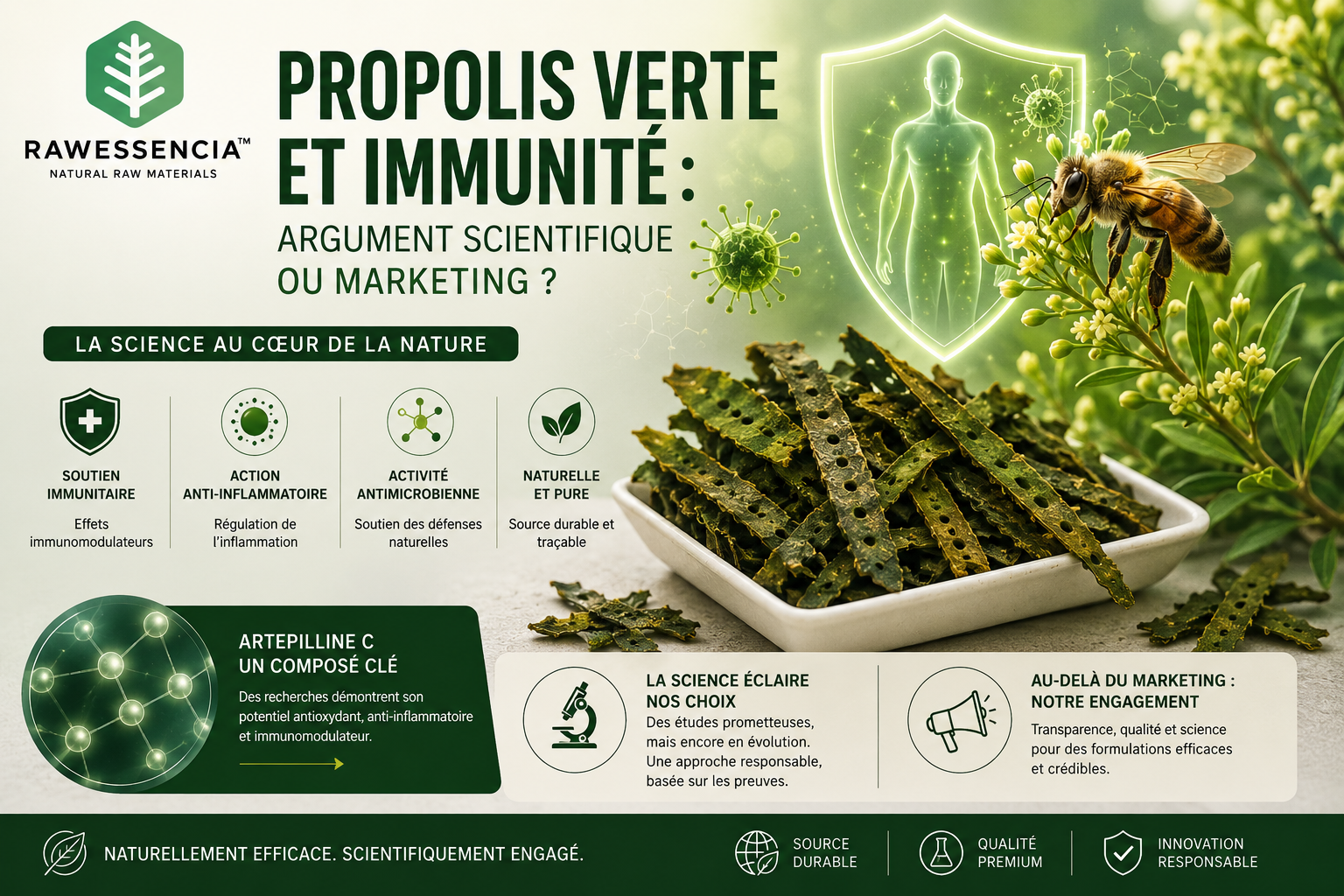
Green Propolis and Immunity: Scientific Evidence or Marketing Claim?
Green Propolis and Immunity: Science vs Marketing Explained
Green Propolis and Immunity: Between Science and Marketing
In recent years, immune health has become one of the most powerful drivers in the nutraceutical and natural health markets. Among the trending ingredients, green propolis has gained significant attention.
But a key question remains for formulators and brands:
👉 Is green propolis a scientifically validated immune-support ingredient, or mainly a marketing-driven claim?
A Market Driven by Immunity Claims
The global demand for immunity-boosting products has surged, leading to:
- rapid growth of natural supplements
- increased use of botanical actives
- strong competition between brands
👉 In this context, ingredients like green propolis are often positioned as “immune boosters”.
However, the reality is more nuanced.
What Science Actually Says About Green Propolis
Immunomodulatory Effects
Scientific studies suggest that green propolis may:
- interact with immune cells
- support immune response regulation
- contribute to inflammatory balance
👉 This positions green propolis as an immunomodulatory ingredient, not a direct stimulant.
Anti-Inflammatory Activity
Green propolis contains bioactive compounds (notably artepillin C) that:
- reduce inflammatory mediators
- regulate cytokine activity
- help control oxidative stress
👉 This is key, as immune health is closely linked to inflammation control.
Antimicrobial Support
Research also highlights:
- antibacterial activity
- antifungal potential
👉 Supporting the body’s natural defenses rather than “boosting” immunity directly.
The Limits of Scientific Evidence
To maintain a credible B2B position, it is essential to acknowledge limitations:
- many studies are in vitro or preclinical
- limited large-scale human clinical trials
- variability depending on extract quality
👉 Not all green propolis ingredients are equal.
Where Marketing Goes Too Far
In the market, some claims oversimplify reality:
- “boosts immunity instantly”
- “natural immune shield”
- “clinically proven” (often overstated)
👉 These claims can:
- create confusion
- reduce credibility
- expose brands to regulatory risks
The Right Positioning Strategy (B2B Insight)
Instead of overpromising, the most effective positioning is:
❌ Avoid:
- miracle claims
- exaggerated immune benefits
✅ Focus on:
- scientific potential
- mechanism of action (immunomodulation, inflammation control)
- natural origin and composition
What It Means for Product Development
For formulators and brands, this translates into:
1. Smart formulation strategies
- combine green propolis with:
- vitamin C
- zinc
- probiotics
👉 Build a multi-mechanism immune support product
2. Evidence-based storytelling
- highlight scientific studies
- explain mechanisms clearly
- avoid overclaims
3. Quality-driven differentiation
- standardized extracts (artepillin C content)
- traceability
- controlled sourcing
👉 Quality = credibility.
Turning Science into Market Value
Green propolis becomes a strong asset when positioned as:
- a supportive immune ingredient
- part of a holistic health approach
- a natural, science-backed active
Conclusion
Green propolis is neither just a marketing claim nor a miracle ingredient.
👉 It is a scientifically promising natural active, whose effectiveness depends on:
- formulation strategy
- ingredient quality
- communication accuracy
For B2B players, the real opportunity lies in bridging science and marketing intelligently.
FAQ
Does green propolis boost immunity?
Green propolis supports immune function through immunomodulatory and anti-inflammatory effects rather than directly boosting immunity.
Is green propolis scientifically proven?
It is supported by preclinical research, but more human clinical studies are needed.
How should green propolis be used in formulations?
It works best in combination with other immune-support ingredients like vitamins, minerals, and probiotics.