
Biochemical Comparison: Liquid vs Lyophilized Snail Mucin
Stability, Bioavailability, and Cosmetic Formulation Implications
🔬 Introduction
Snail mucin (snail secretion filtrate) has become a key active ingredient in dermocosmetics due to its hydrating, repairing, and anti-inflammatory properties.
However, a critical distinction remains largely underexplored in the industry:
👉 liquid vs lyophilized (powder) form
For formulators and brands, this choice directly impacts:
- active ingredient stability
- biological performance
- industrial constraints
🧬 Biochemical Composition of Snail Mucin
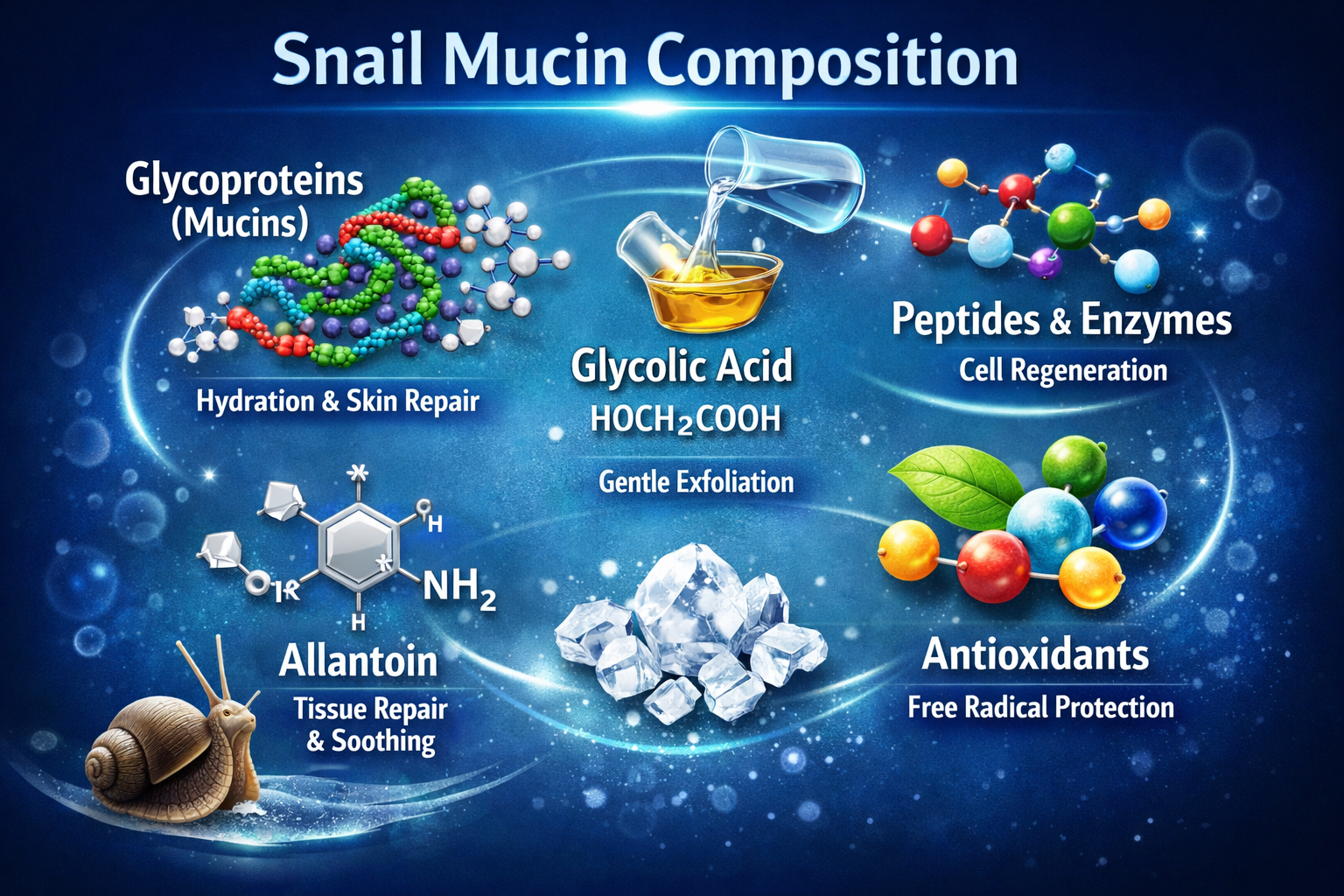
Snail mucin is a complex matrix containing:
- Glycoproteins (mucins) → hydration and protective film
- Glycolic acid → gentle exfoliation
- Allantoin → tissue repair
- Peptides & enzymes → cellular regeneration
- Natural antioxidants → protection against oxidative stress
👉 This biochemical richness is precisely what makes its stability critical.
💧 Liquid Snail Mucin: Characteristics
✔️ Advantages
- Ready-to-use in formulations
- Good dispersibility
- Familiar to formulators
❌ Major Limitations
1. Biochemical instability
- Rapid degradation of peptides and enzymes
- Sensitivity to temperature and oxidation
2. Active dilution
- Often low actual concentration
- Batch-to-batch variability
3. Preservative dependency
- Requires strong preservation systems
- Risk of interactions with active ingredients
4. High logistical costs
- Transporting water → low active density
❄️ Lyophilized Snail Mucin: Characteristics
Lyophilization is a process that removes water at low temperatures, preserving biological structures.
✔️ Key Advantages
1. Maximum active stability
- Preservation of peptides and enzymes
- Drastic reduction in degradation
2. High concentration
- Pure active (water-free)
- Precise and reproducible dosing
3. Improved potential bioavailability
- Better preserved actives → intact biological activity
4. Extended shelf life
- Significantly longer stability
5. Logistics optimization
- Reduced volume and weight
⚖️ Direct Comparison: Liquid vs Lyophilized
| Criteria | Liquid | Lyophilized |
|---|---|---|
| Stability | Low to moderate | Very high |
| Concentration | Highly diluted | Pure active |
| Bioavailability | Variable | Optimized |
| Preservation | Requires preservatives | More stable |
| Transport | Costly | Optimized |
| Reproducibility | Variable | Standardized |
🧪 Impact on Bioavailability
Bioavailability depends on several factors:
- peptide integrity
- glycoprotein stability
- absence of enzymatic degradation
👉 Lyophilization allows to:
- preserve mucin structure
- maintain biological activity
- improve performance in topical applications
💡 In practice:
A degraded active in solution → reduced efficacy, even at high concentration.
⚗️ Implications in Cosmetic Formulation
With liquid form:
- Suitable for simple formulations
- Less control over actual concentration
- Risk of final product variability
With lyophilized form:
- Enables premium formulations
- Ideal for:
- high-performance serums
- active ampoules
- professional treatments
👉 Requires:
- controlled reconstitution step
- pH and solvent management
🏭 Industrial Implications for Brands
The choice of format directly impacts:
🔹 Product positioning
- Liquid → entry-level
- Lyophilized → premium / dermocosmetic
🔹 Perceived quality
- Standardization = consumer trust
🔹 Scalability
- Batch reproducibility improved with powder
🚀 Conclusion
This biochemical comparison highlights a key reality:
👉 Lyophilized snail mucin clearly outperforms liquid forms in terms of stability, concentration, and biological performance.
For brands and formulators aiming to develop products that are:
- effective
- differentiated
- premium
➡️ lyophilized form is currently the most advanced solution available.